
What is an exchange inflow alert?
It fires when a large wallet sends BTC, ETH, USDT, or another tracked asset to a known exchange wallet. Funds arriving at Binance, Coinbase, or OKX can increase sell-side liquidity.

Whale Alerts watches large transactions, exchange inflows & outflows, and smart-money wallets across 5+ blockchains — and pings your Telegram in seconds.
 $194.2M Kraken: Hot Wallet ➔ bc1qct...7p72 + Exchange outflow just now
  $499.3M Binance: Hot Wallet ➔ Tether: Treasury + Exchange outflow just now $191.9M Abraxas Capital Mgmt (Heka Funds): Alpha Bitcoin Fund ➔ Kraken: Kraken Deposit ! Distribution just now
  $4M Abraxas Capital Mgmt (Heka Funds) ➔ Binance Deposit ! Distribution just now
  $42M Kraken: Cold Wallet ➔ 0xd865...dc44 + Exchange outflow just now


Alerts tell you a whale moved. The dashboard tells you what it means — a live Whale Sentiment Gauge, plain-English Whale AI insights, and exchange netflow mapped against price.
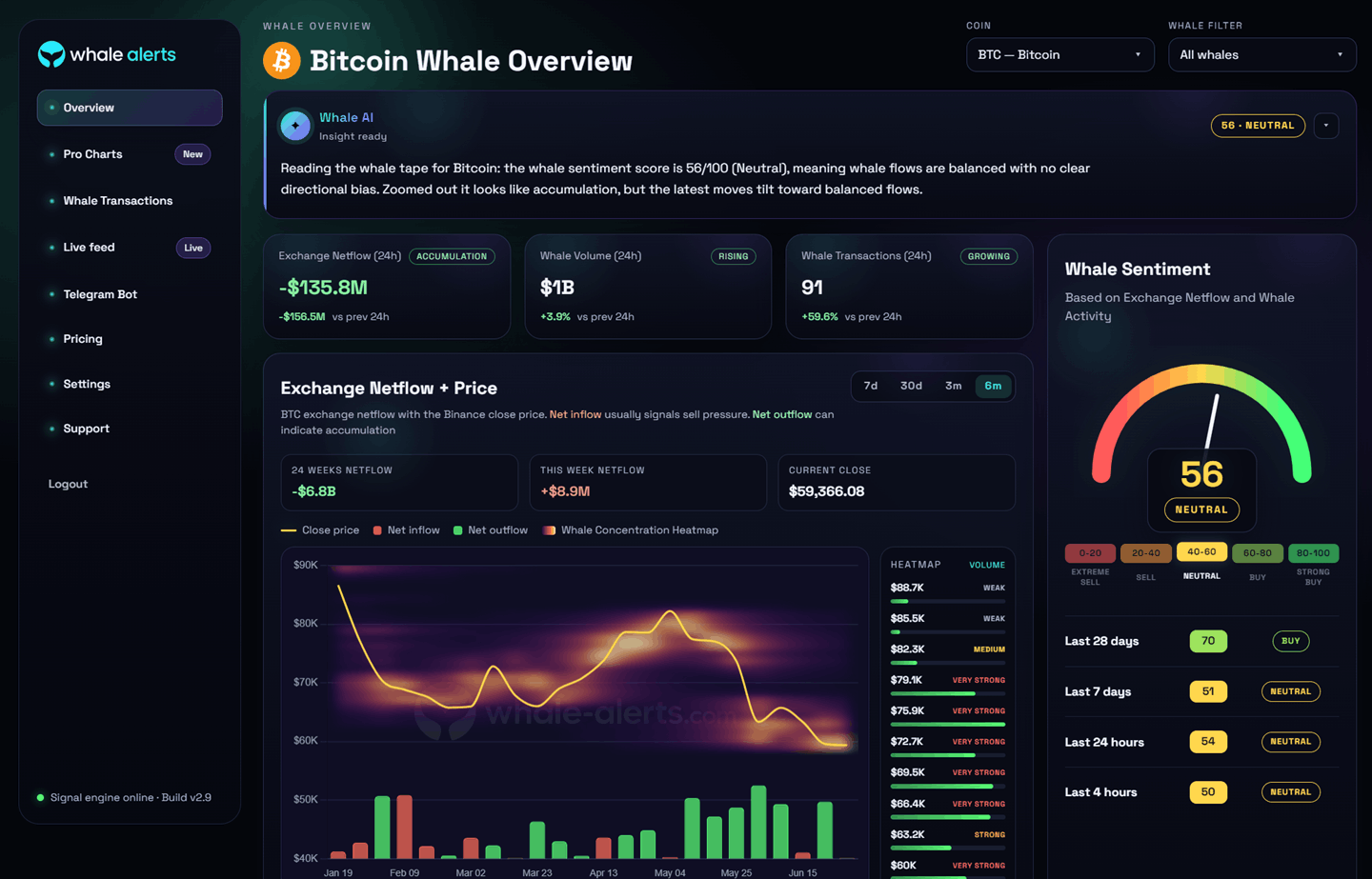
A 0–100 score that blends exchange netflow and whale activity into one clear read — sell, neutral, or buy.
Plain-English summaries of the tape, so you instantly know what the latest whale flows actually mean.
Exchange inflows and outflows mapped against price, so you spot accumulation and sell pressure early.
Each public directory leads to live transfers and verifiable transaction details.
Token amounts, wallet entities, and signal types — no heavy dashboards. Spot sell pressure from big exchange deposits or quiet accumulation into cold storage.
$191.9M Custom thresholds by chain, coin, signal, and wallet entity.
It fires when a large wallet sends BTC, ETH, USDT, or another tracked asset to a known exchange wallet. Funds arriving at Binance, Coinbase, or OKX can increase sell-side liquidity.
Each alert combines on-chain data, transfer size, wallet labels, and flow direction, then separates inflows, outflows, accumulation, mints, burns, and cold-storage moves so the feed stays readable in volatile markets.
Alerts only matter when they arrive instantly. Get a broad real-time feed in the public channel, or use the private bot to filter the exact inflows, outflows, mints, and burns you care about.
Fast, focused, and built for traders who want signal over noise.
Large transfers surface the moment they confirm on-chain — no refresh, no waiting.
Filter by chain, coin, signal, and minimum USD value so you only see what matters.
Exchanges, custodians, market makers, funds, and bridges — not just raw hashes.
Bitcoin, Ethereum, Tron, XRP, XLM, and major stablecoins in one unified feed.
Pipe filtered alerts straight to a private bot or follow the public channel.
Events ranked by size, asset, entity, and direction so big moves never get buried.
Nodes and indexed sources stream large transfers from Bitcoin, Ethereum, altcoins, and stablecoins in real time.
Wallet clusters identify exchanges, custodians, market makers, funds, bridges, and unknown whale addresses.
Matching events hit the live dashboard or your Telegram with amount, entity, direction, and signal type.
On-chain data paired with wallet entity labeling, so a route is not just a hash — it can be Binance Hot Wallet, Coinbase Prime, an OTC desk, a bridge, a treasury, or an unknown address.
The public Telegram channel is great for market-wide alerts. Paid plans add private bot delivery, custom thresholds, deeper history, and dashboard filters.
Start tracking whales for free.
Every coin we track, fully unlocked.
Add serious charting tools.
The full analytics arsenal.
Direct answers about crypto whale alerts, exchange flows, custom filters, and labeling.
Crypto whale alerts are notifications for unusually large blockchain transfers made by major wallets, exchanges, funds, or treasuries. They can reveal liquidity shifts, potential sell pressure, accumulation, or capital rotation before they show up in price action.
A Bitcoin whale inflow to an exchange can increase the BTC available to sell, which may add short-term pressure if followed by selling. It is not a guaranteed signal, so Whale Alerts pairs the inflow with entity labels, size, history, and market context.
Yes. Private plans let you filter alerts by asset, minimum USD value, chain, signal type, and entity category, so you can track specific altcoins, stablecoins, or smart money wallets without receiving every public update.
Labeling is built from on-chain behavior, public tags, exchange infrastructure patterns, and continuous review. Labels reduce noise, but every alert still links back to the transaction and wallet address so you can verify the source.
Whale Alerts tracks major liquidity networks including Bitcoin, Ethereum, Tron, XRP, XLM, USDT, USDC, and other high-volume assets — the chains where large transfers and stablecoin flows give the most useful market context.
The public channel shows a broad real-time feed for major whale transactions. The private Telegram bot adds custom filters, cleaner routing, and personal thresholds so you only receive the alerts that match your strategy.
Watch live whale transactions, follow exchange inflows and outflows, and route the alerts that matter to Telegram. Fast dashboard, focused notifications, verifiable wallet labels.

